Intense Impressionism and Daniel Wall

With Claude Monet, Edgar Degas, Camille Pissarro, Pierre-Auguste Renoir among others are known for being the fathers of Impressionism in the 19th century; Daniel Wall is making his name as the founder of Intense Impressionism.
Information found on Park West Galley => Daniel Wall began drawing and painting at the age of 4. His first art teacher was his mother, a talented and diligent self-taught artist. Wall earned numerous art awards in his childhood and was accepted into a fine art academy when he reached his teens. He went on to study art in China, Italy, and the United States.
Wall’s artistic development was enhanced through his exposure to a variety of cultures and solidified through his extensive experience as an art instructor, illustrator, art editor, and fine art professor. He made a decision to become a professional artist after receiving his Master’s degree from Georgia Southern University. He has published hundreds of illustrations in journals and books, has exhibited widely, and won awards in China, Germany, Italy, Japan, Spain, and the United States.
Wall describes his work as “Intense Impressionism,” and as a means of extending the Impressionist approaches made famous in the 19th Century into the 21st century. He views his work as a reflection of contemporary times.
Influenced by the Impressionists, principally Monet, Pissarro, Sisley, and Seurat, Wall has extended the concepts of the impressionists into a contemporary dialog. The idea of allowing the brushwork to be fully evident, and even imbuing his pigment applications with an expressionist energy re-invigorates the impressionist style and has allowed Wall to find his own unique approach.
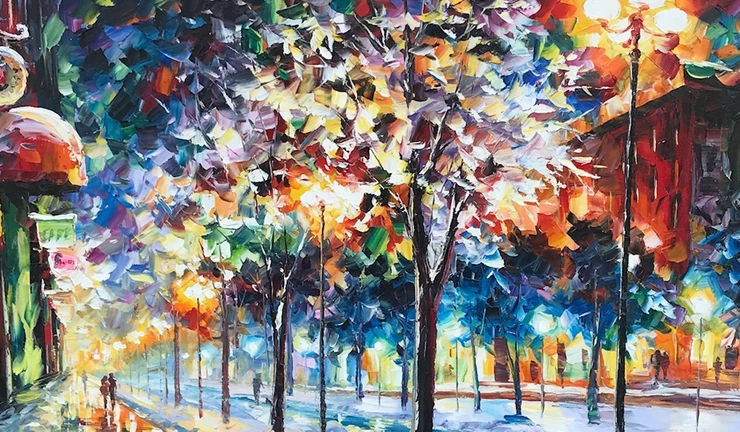
Initially developed in the 1980s, Wall’s bold imagery is characterized by large, forceful and conspicuous strokes created with a palette knife using heavy textures and thick impasto. He employs vibrant colors and achieves striking lighting effects.
He also attaches specific symbols to certain elements in his art and describes light as a representation of hope; the open sky, freedom; a road, as the path of life; water, as emotion, among other visual references, all pointing toward an optimistic and joyful view of life.
Wall is also adept a juxtaposing color to create striking contrasts and dramatic effects. His many years of training have allowed him to develop the knowledge of color relationships to be able to accomplish his extraordinary dramatic effects. At first glance, his combinations of colors, with their warm and cool, dark and light contrasts may appear spontaneous, but further viewing reveals his dedication to a fixed light source and too strong fundamental drawing, which brings his compositions into focus. These qualities also demonstrate his artistic integrity and his appreciation for the art of the past masters.
Wall now resides and paints in North Carolina in the United States. His paintings continue to be widely collected in the United States and around the world.
This new art movement carries Impressionism from the 1800s into the 21st century with boldness, noticeable strokes formed with a palette knife, intense texture with heavy paints, vibrant colors, and exaggerated striking effects of lights.
Some of the differences we can see between Impressionism and Intense Impressionism are:
1. Impressionist paintings have relatively small visible brush strokes while Intense Impressionism art has bold, strong, heavy strokes created with a palette knife.
2. Impressionist paintings emphasize on accurate depiction of light; while Intense Impressionism paintings exaggerate the effects of light.
As you look through Daniel Wall’s paintings, you can easily feel and smell his work; the orchestra of colors transports you into an everlasting symphony.



Post a comment